Educational

SOYEZ PRUDENTS!
SEI VORSICHTIG!
SOYEZ PRUDENTS!
SEI VORSICHTIG!


 Perseo Vincitore
Benvenuto Cellini
Loggia dei Lanzi, Firenze
⚔ Perseo, gli Argonauti e la Difesa Psicologica
Nella mitologia greca, Perseo sconfisse Medusa usando lo scudo-specchio di Atena — non la forza bruta, ma la conoscenza e la preparazione. Gli Argonauti, guidati da Giasone sulla nave Argo, superarono prove mortali grazie all'intelligenza collettiva e al coraggio condiviso. Questi archetipi eroici incarnano la stessa strategia antifrode che proponiamo: informazione, prevenzione, azione collettiva contro i moderni truffatori-Medusa.
Psychological defense: documents and presentations
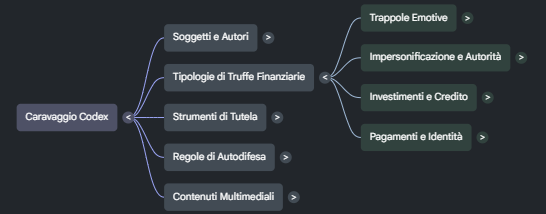 Caravaggio Codex (PDF)
 Financial Fraud Defense (PDF)
 Architecture of Deception (PDF)
 Medusa Paralyzing (PPTX)
Common online financial scams and the most useful defense before you pay
People are rarely trapped by a single trick. In most cases the scammer combines urgency, fake authority and an apparently convenient offer. The real defense is to slow the process down, verify every detail outside the scammer's channel and refuse to move money until the basic checks are complete.
Use these thematic buttons to jump directly to the risk area you want to study, then return to the summary
from each section.
Warning: these "secret rooms" expose scam tactics.
Follow the guided sequence and verify every move before opening links or actions.
Social pressure and emotional traps
Authority abuse and impersonation
Investments, credit and recovery traps
Shopping, payments and transfer fraud
Identity and account control
Psychological defense and awareness
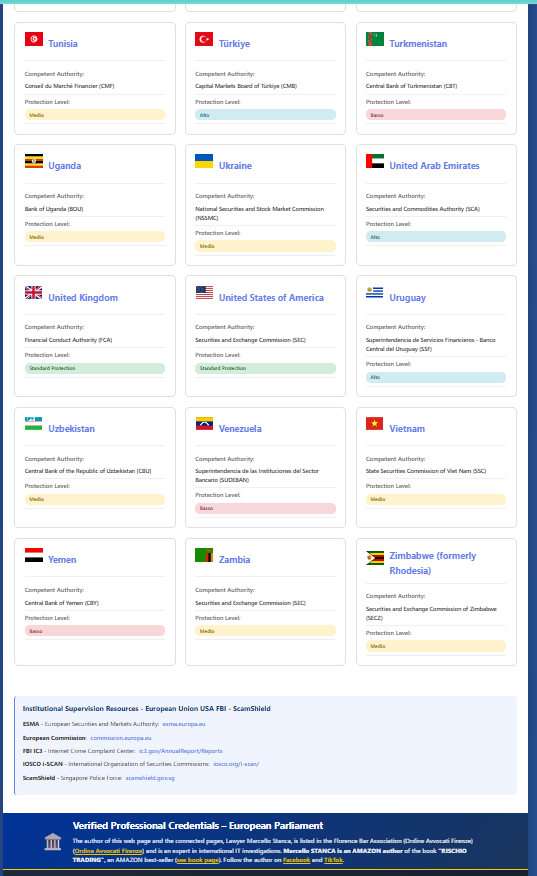
🌍 189 Financial Authorities — Flag Alphabet
Click any flag to see the financial authority, fraud report link and contact details for that country.
⚠️ Report Suspect Entity
Verification request to Financial Authority
ℹ️ Data will be sent to your email so you can contact the Authority.
A copy goes to the administrator for the public Warning List.
🛡️ Practical Legal Guide – Verifying a Financial Firm in 5 Steps
Authority:
Scheda Medusa: archetipo storico e difesa antifrode
Il banner verticale di Medusa introduce la stessa metafora visiva sviluppata qui: la paura che paralizza, il riflesso che smaschera l'inganno e la conoscenza come scudo che restituisce azione.
🖼 Medusa di Caravaggio (1597)
1597, olio su tela montata su scudo convesso in legno di fico. Michelangelo Merisi da Caravaggio dipinse questo capolavoro come dono per Ferdinando I de' Medici, Granduca di Toscana. L'opera cattura l'istante in cui Medusa, decapitata da Perseo, vede il proprio riflesso nello scudo: l'orrore, il grido, i serpenti ancora vivi. Caravaggio rovescia il mito — il mostro diventa vittima del proprio inganno.
La modernità del messaggio è straordinaria: chi usa la paura come arma finisce per esserne distrutto. I truffatori-Medusa di oggi — phishing, spoofing, social engineering — usano le stesse leve psicologiche: paralisi, confusione, terrore. Ma come Perseo, chi conosce il trucco può difendersi.
🏛 L'originale rinascimentale è conservato nella Galleria degli Uffizi, Firenze, Italia. Visita la scheda ufficiale dell'opera → uffizi.it
⚔ Perseo Vincitore di Benvenuto Cellini (1545-1554)
1545–1554, fusione in bronzo, altezza 320 cm. Nella parte superiore di questa pagina, sopra il banner centrale, l'immagine del Perseo di Cellini rappresenta l'archetipo della rivincita: l'eroe che sconfigge il mostro usando intelligenza, preparazione e lo scudo-specchio di Atena.
Benvenuto Cellini, orafo, scultore e scrittore fiorentino del Rinascimento, creò questa monumentale statua per Cosimo I de' Medici. L'opera rappresenta Perseo in piedi sul corpo decapitato di Medusa, brandendo la testa mozzata — simbolo universale del trionfo della ragione sulla manipolazione.
La fusione del bronzo fu un'impresa leggendaria: Cellini racconta nella sua autobiografia di aver rischiato la vita quando il metallo si solidificò prematuramente, costringendolo a gettare nel crogiolo piatti e posate per completare l'opera. Il risultato è uno dei capolavori assoluti della scultura mondiale.
🏛 La statua originale è esposta nella Loggia dei Lanzi, Piazza della Signoria, Firenze. Una copia in bronzo si trova nel cortile di Palazzo Vecchio.
🇮🇹 Italy — Forze di Polizia e canali ufficiali di denuncia
Country: Italy · work in progress
Questa sezione autonoma collega direttamente alle pagine istituzionali per denunciare crimini informatici, criminalita economica e frodi in Italia.
Video Avatar: educational and motivational short clips
To improve performance, heavy media are now loaded from a dedicated external hub (Canvas / Google Drive / OneDrive links) instead of being embedded in this page.
🧠 Mental Health Impact — Psychological Support for Fraud Victims
Financial fraud can cause trauma comparable to physical aggression. These resources provide psychological first aid, recovery programs and helplines for victims and their families.
🇺🇸 AARP — Fraud Watch Network
Specialized program on the psychological impact of financial scams on the elderly. Offers therapeutic support, emotional recovery resources and peer-to-peer groups to combat shame and isolation after fraud.
🧠 Mental Health Impact📞 Emergency Helplines
If you or someone you know is experiencing emotional distress after financial fraud, contact these free confidential services: Telefono Amico (IT: 02 2327 2327), Samaritans (UK: 116 123), SAMHSA (US: 1-800-662-4357).
📞 Telefono Amico Italia💔 Post-Fraud PTSD & Recovery
Victims of financial fraud can develop clinical depression (25% of cases), persistent anxiety, paralysing shame and social isolation. Early recognition and professional support are essential for recovery.
💔 Mind UK — PTSD Guide👨👩👧 Family Support & Elder Protection
Financial exploitation of the elderly often stays hidden due to shame. Families should watch for sudden secrecy about finances, unexplained transfers, anxiety around phone calls and unusual urgency about money.
👨👩👧 APA — Elder PsychologySocial pressure and emotional traps
Keywords: job scam, romance scam, fake charity
These frauds work by manipulating trust, urgency, compassion or personal vulnerability before the victim has time to verify the story.
Job scam and fake remote work
A job scam promises easy money for simple actions: liking content, filling in forms, forwarding bank transfers, renting out your account or buying materials that will allegedly be refunded later. The target is often hooked with a small initial payment to make the scheme look real.
The safest rule is to reject any offer where the worker must send money first, use a personal account for third parties or hand over documents before a verifiable interview. A real employer does not turn the candidate into a financial intermediary.
Common warning signs often include requests to pay before hiring, instructions to use your personal bank account for third parties, pressure to move money through crypto or instant transfers and interview processes that never lead to a verifiable employer identity. A legitimate recruiter should be able to identify the employer clearly and explain why any payment or document is needed.
- Upfront payment for training, devices or onboarding.
- Request to receive and forward transfers through your own account.
- Only chat-based contact with no verifiable company identity.
- Request for sensitive ID documents before a verifiable interview, or through chat-only non-corporate channels.
If the offer mentions investments, wallets, recovery, financial onboarding or transfers to a named beneficiary, use the Authority check before you pay. If the transfer involved an Italian bank and a later refund is disputed, review the ABF section as a possible next step.
Romance scam, social engineering and fake emergencies
Relationship scams build trust for weeks or months. Once the emotional bond is strong, the emergency appears: illness, travel trouble, customs problems, a shared investment, a blocked wallet or an urgent loan. At that point the victim is no longer evaluating money, but the relationship.
A healthy response is to add an outside check every time: talk to someone who is not emotionally involved, verify photos and identity and keep one simple rule. Never transfer money to a person you have never met in a verifiable way.
Romance scam often follows a repeatable script: rapid emotional intensity, excuses to avoid in-person verification, a private crisis that demands secrecy and finally a request for money through bank transfer, gift cards, top-up codes or crypto wallets. The manipulation often works by isolating the victim from independent verification.
- The relationship becomes unusually intense in a very short time.
- Repeated reasons are given to avoid a live and verifiable meeting.
- An emergency appears and money is requested with unusual urgency or secrecy.
- You are discouraged from involving family, friends or your bank.
If shame, panic or emotional confusion make it harder to assess the situation clearly, stop the payment decision and use an outside check immediately. The mental health support section helps frame the trauma response, while the Authority check helps you verify names, websites and payment requests before further losses.
Fake charity and emotional donation fraud
Fraudulent charity campaigns appear after wars, disasters, medical emergencies or public tragedies. They use moving images, copied logos and dramatic appeals to push donors to act quickly before checking who will really receive the money.
The safest behavior is to donate only through official websites you reach independently, checking legal identity, bank details and public references. If the request insists on instant transfers to personal accounts, it is a warning, not a cause.
Deepfake voice scam and cloned family emergency calls
Voice cloning lets criminals simulate a relative, a manager or a trusted colleague well enough to trigger panic. The call sounds emotional, rushed and specific. The victim is pushed to send money fast before asking questions that would expose the deception.
Create a verification habit before emergencies happen: use a family code word, call back on a known number and confirm the request through a second channel. The more urgent the story sounds, the more disciplined the verification must become.
Authority abuse and impersonation
Keywords: phishing, fake banker, tax refund scam
These schemes borrow the tone of banks, lawyers, public bodies and support desks to make unsafe actions look official and urgent.
Phishing, bank spoofing and altered IBAN fraud
Phishing does not live in email alone. It arrives by SMS, phone call, search result, fake certified message and even notes that appear to come from a bank or lawyer. The goal is always the same: make you click, reveal codes or pay to manipulated bank details.
The strongest defense is to ignore the suspicious link and open the website manually instead. Then call the official number found on real documents and compare the IBAN with an independent source before authorising any payment.
Fake bank officer and security-call fraud
In this scam the caller sounds professional, knows basic personal details and claims to be protecting your account from fraud. The conversation is designed to create trust while pushing you to reveal codes, approve a device, move funds to a so-called safe account or install a security app.
The right defense is to end the call and contact your bank yourself using the number printed on official documents or the banking app. A real bank employee does not need you to transfer money away from your own account to keep it safe.
7 October 2025
SMS plus fake bank call: twelve transfers to Lithuania
Roma Today reported the case of a Roman customer tricked by an SMS followed by a fake security call, with twelve transfers sent to a Lithuanian bank in just over two hours.
The ABF then recognised a partial refund, noting that the bank should have detected the anomaly and activated stronger monitoring and automatic blocking.
Read the Roma Today articleFake lawyer scam and invented legal pressure
This fraud uses legal language, stamps, copied signatures and urgent deadlines to scare the victim into paying. The message may claim to come from a law firm handling debt, copyright, inheritance, recovery or urgent settlement activity.
The correct response is to verify the lawyer independently through an official register or a number you find yourself, never through the contact details included in the threatening message. Real legal communications do not collapse when you ask for verification.
Tax refund scam and fake public authority notices
This scam claims you are entitled to a refund or that a tax irregularity must be fixed immediately. The message imitates an official authority, uses formal language and includes a link or attachment designed to capture banking data, credentials or identity documents.
The best defense is to ignore the embedded link and access the public service portal directly from a trusted bookmark or manual search. Official agencies do not need urgency and secrecy to return money that is legitimately yours.
Fake technical support and remote access fraud
The fake support scam appears through popups, phone calls or messages warning about viruses, blocked banking apps or compromised devices. The attacker tries to convince the victim to install remote control software or reveal one-time codes during the so-called repair.
A real operator does not need to scare you into immediate access. Close the popup, disconnect the call and contact the official support number yourself from a trusted source. If someone asks for remote control while you are logged into banking or email, stop instantly.
Vote for the dancer on WhatsApp? It may be a trap.
A recent WhatsApp scam asks you to vote for a dancer or a girl in a contest. The message looks harmless and often appears to come from a trusted contact, but the link can capture data from your smartphone and then use the compromised account to send money requests to your contacts.
- Do not open the voting link and do not enter codes, names or login data on pages reached from the chat.
- If you clicked, warn your contacts immediately, review linked devices and secure the account before the scam spreads further.
- Treat every request to vote, help a dancer or support a contest through a rushed link as suspicious, especially if it is followed by requests for money or verification codes.
How to query financial authorities before you trust a site
When a website offers trading, crypto, investments, credit, recovery or financial advice, the most prudent move is to contact the competent authority directly and ask for written confirmation before you pay, register or continue the conversation.
- Ask whether the entity really exists and whether it is authorised to offer financial services in your country of residence.
- Ask whether the website or domain name you found is officially linked to that entity, or whether it may be a clone or an abusive use of identity.
- Ask for the official public telephone number of the entity you want to verify, so you can call back using an independent contact.
- Ask whether the person who contacted you is registered in the official register of financial promoters or authorised advisers allowed to provide investment advice to the public.
- Ask whether warnings, sanctions or public notices already exist regarding that name, website, phone number or offer.
Keep the authority reply, the web address, the phone number used by the caller and the name presented by the contact in the same file. If the answers are incomplete, contradictory or only verbal, do not move money and do not send documents yet.
Ask 190 Financial Authorities for confirmation
You$ - Your Financial Shield
This operating card condenses a simple self-defense routine: before you trust a financial website, broker, crypto platform or recovery service, verify the country, the competent authority and the real identity of the operator.
- Open the Financial Authorities Database (190) and search for the country named by the operator or shown on the website as its registered location.
- Identify the competent financial authority for that country: central bank, supervisory authority or market regulator.
- Send a short written request to the authority, or use the official Avv. Stanca site, and ask for confirmation before paying, registering or sending documents.
Simple message you can copy and adapt
- Tell me whether this company really exists as a financial or insurance firm.
- Tell me whether it is authorised to offer financial services in my country of residence.
- Tell me what its official website address is.
- Tell me what its official email address is.
- Please note any abusive financial activity or possible cloning of a legitimate firm's identity.
- You may reply to me by email at the address I provide, and I may or may not require further legal assistance.
This internal card is useful for deposits, wallet transfers, fake trading offers, recovery proposals and every situation where the other side asks you to act with urgency.
Open the Financial Authorities Database (190)Arbitro Bancario Finanziario: out-of-court dispute resolution
The Arbitro Bancario Finanziario is an out-of-court system for resolving disputes between customers and banks or other financial intermediaries. It is useful when you need to challenge unauthorised transfers, abnormal account operations, refund refusals or conduct that may not have met the required banking diligence.
Before going to court, this channel can help structure the dispute with documents, chronology and concrete objections. It is especially relevant when the issue concerns anomalous transactions, missing monitoring, delayed blocking or disputed payment operations.
Open the ABF official website Watch the Bank of Italy explainer videoInvestments, credit and recovery traps
Keywords: trading scam, crypto scam, loan scam
These schemes promise profit, education, rescue or easy credit, but their real objective is always an upfront payment or loss of control over funds.
Online trading, fake brokers and miracle investments
Many financial scams start with aggressive ads on social platforms, search engines or private chats. The fraudster displays a polished platform, a fake adviser and steady profits. As soon as the victim asks to withdraw, invented taxes, technical blocks or new deposit requests appear.
The concrete defense is to verify licence, registered office, independent contact details and outside reputation before sending anything. If someone pushes you to deposit immediately so you do not miss the opportunity, the urgency itself is already a warning.
Crypto scam, fake wallets and copied exchanges
Crypto fraud often starts with a fake tutor, a cloned exchange, a private group or a recovery promise. The victim is pushed to move funds to a wallet they do not control or to authorise a temporary transfer that is supposed to unlock profits.
The best defense is simple: never send coins to a wallet shared only in chat and verify the exchange URL character by character. If you cannot confirm the destination independently on a trusted device, do not move anything.
Investment academy scam and paid mentorship traps
These scams imitate educational programs, trading academies or elite investor communities. The victim is first sold a course, then a premium signal group, then a managed opportunity that supposedly works only if more money is deposited quickly.
A useful defense is to separate education from custody of funds. You can study finance without giving strangers access to your wallet, exchange account or capital. When learning and money transfer are tied together, caution should rise immediately.
Recovery room, fake fund recovery and double victimisation
After the first loss, fake investigators, improvised legal offices, crypto experts or invented associations appear and promise to recover everything in a few days. They request an advance for taxes, notarisation, unlock wallets or fictional international procedures.
If you have already been scammed, preserve evidence, block the contact channels and speak only with verifiable counterparts. A real recovery path does not rely on pressure in chat and does not guarantee impossible outcomes. The first defense here is not to pay a second time.
Loan scam and fake easy-credit approval
Loan scams target people who need quick liquidity. The fraudster promises guaranteed approval, no checks or instant release of funds, then asks for upfront fees, insurance costs, notarisation or verification payments before the money can supposedly be transferred.
A reliable lender deducts legitimate costs transparently or documents them through formal contracts, not urgent chat pressure. If credit is promised to everyone but money must be sent first, the offer is almost certainly a trap.
Pyramid scheme and chain letter fraud (Catena di Sant'Antonio)
A pyramid scheme disguises itself as a business opportunity, a solidarity circle, a gift exchange or a mutual aid group. Each participant must recruit new members and contribute money that flows upward. Early joiners may receive a payout, which makes the system look real, but the structure is mathematically unsustainable: it requires an exponentially growing number of recruits, and when recruitment slows the entire chain collapses, leaving the vast majority with a loss.
Modern variants appear as social media challenges, WhatsApp or Telegram groups, crypto staking circles or gifting tables. The language avoids the word pyramid and instead uses community, rotation, solidarity or multiplication. The constant element is always the same: your return depends on convincing others to pay in after you.
The clearest warning sign is that the income does not come from a product or service sold to an external market, but exclusively from new participants' contributions. In many countries, including Italy (Law 173/2005) and across the EU, organizing or promoting a pyramid scheme is a criminal offence. If an offer requires you to pay to join and then earn mainly by recruiting others, it is a pyramid — regardless of the name it uses.
How can you protect your WhatsApp account?
To secure your WhatsApp account, activate two-step verification from Settings, choose a 6-digit PIN, add a recovery email and lock the app with fingerprint or Face ID. Then protect sensitive chats with chat lock and a secret code.
- Enable two-step verification from Settings > Account > Two-step verification > Turn on, then set a 6-digit PIN and a recovery email.
- Activate app lock with fingerprint or Face ID from Privacy so nobody can open WhatsApp if they get your phone.
- Use chat lock to hide specific chats: press and hold the chat, open the menu and activate the lock.
- Add a secret code for locked chats to hide them further and reduce exposure if someone inspects the app.
Shopping, payments and transfer fraud
Keywords: marketplace fraud, invoice scam, QR code scam
These frauds target everyday purchases, invoices, bookings and transfers, usually by moving the victim outside a trusted payment flow.
Fake products, cloned shops and unbelievable offers
Clone websites sell phones, cars, appliances, tickets or luxury goods at unrealistic prices. They copy famous logos, generic terms and convincing photos, but behind the surface the goal is to collect payment without delivering anything or to ship something completely different.
Before buying, check the domain, company data, real address, return policy and independent reviews. If the only accepted method is a transfer to an unknown IBAN, stop the purchase. No discount is worth that risk.
Marketplace fraud and fake buyer protection links
Marketplace fraud affects both sellers and buyers. A fake buyer sends a payment link outside the platform, or a fake seller requests a deposit to reserve the item. The conversation feels normal until the victim leaves the protected system and enters a cloned page.
Stay inside the marketplace chat, payment flow and shipping tools whenever possible. The moment the other party tries to move the deal to an external link, courier shortcut or instant refund page, stop and re-evaluate the entire transaction.
Parcel scam and fake delivery problems
Parcel scams exploit curiosity and routine. A text says your shipment is blocked, customs are unpaid or an address must be confirmed. The fee looks tiny, but the real goal is to steal card data, credentials or identity details through a fake courier page.
The practical defense is to track deliveries only from the official courier app or website that you open directly. If you were not expecting a parcel, or if the message asks for urgent payment through an unfamiliar link, treat it as suspicious from the start.
QR code scam and hidden payment redirection
QR code scams work because people trust visual shortcuts. A sticker can replace a real payment code at a parking meter, on a poster, in a restaurant or inside a fake invoice. One scan is enough to open a malicious page or to redirect payment to a different beneficiary.
Before confirming anything, check the destination shown after the scan, inspect the physical code for tampering and prefer typing known addresses manually when the context involves banking or account access. A QR code is a shortcut, not a proof of legitimacy.
Invoice scam and payment redirection fraud
In an invoice scam the victim receives a bill that looks routine: same supplier name, same graphics, similar email thread. The crucial change is hidden in the payment details, where the bank account is replaced so the money reaches the attacker.
A strong defense is to treat every new invoice template, account change or last-minute correction as a separate verification event. Compare the banking details with older records and confirm them by phone with a trusted contact before paying.
Urgent transfer scam and fake supplier IBAN
This fraud targets families and businesses through altered invoices, fake lawyer emails or urgent messages that appear to come from a manager. One changed IBAN is enough to redirect a large payment before anyone notices the difference.
The correct habit is to confirm every new bank detail by voice, using a phone number you already know and never the one written in the suspicious email. A one-minute callback can save an entire transfer.
Gift card scam and irreversible code payments
Gift card fraud appears when a scammer pretends to be a company, tax office, manager or family member and asks for urgent payment through prepaid cards. The method is chosen because the codes can be redeemed quickly and are difficult to recover once shared.
The best rule is absolute: no legitimate institution settles debts, fines, security checks or emergency help through gift card codes. The moment that request appears, stop the conversation and verify the story with an independent contact.
Rental scam and fake property listings
Rental scams present attractive apartments, short-term stays or holiday homes at persuasive prices. The fraudster claims strong demand and asks for a deposit before any real viewing, often hiding behind excuses about travel, keys, platform issues or legal urgency.
Never transfer a deposit for a property you cannot verify through a real viewing, a trusted platform or documented ownership checks. A home can be urgent, but your payment should never outrun your verification.
Identity and account control
Keywords: SIM swap, account takeover, identity theft
These risks aim to seize access, intercept verification or harvest documents that later unlock banking, credit and impersonation fraud.
SIM swap and hijacked verification codes
SIM swap fraud begins when criminals collect enough personal data to convince a phone operator to move your number onto another card. Once they control the line, they intercept one-time passwords and use them to enter banking, email or exchange accounts.
If your phone suddenly loses signal without explanation, react immediately: contact your operator from another line, block sensitive accounts and change passwords from a secure device. Activating stronger authentication than SMS reduces the damage dramatically.
Account takeover and chained identity abuse
Account takeover happens when attackers enter one service and then pivot into others: email, banking, shopping platforms and cloud storage. A single compromised mailbox can become the master key for password resets, card fraud and impersonation.
The best defense is layered: unique passwords, an updated password manager, multi-factor authentication and alert review for new logins. When one account shows suspicious activity, treat every linked service as potentially exposed and rotate credentials in sequence.
Identity theft and document harvesting fraud
Identity theft often begins quietly: a fake form, a bogus verification request, a copied login page or an offer that asks for ID cards, selfies and utility bills. Those documents can later be reused for fraudulent accounts, loans, SIM activation or social engineering.
Before uploading any document, ask why it is needed, how it will be stored and whether the request comes from a verified institution. A cautious habit is to share the minimum necessary and to avoid sending sensitive files through ordinary chat whenever possible.
5 February 2026
Golden Tree: fake bank, fake cards and fake banking app
Operation Golden Tree exposed a fake bank network that looked credible with branded payment cards, offices and even a banking-style app shown to clients.
The lesson is practical: cards, apps and polished language do not prove legitimacy. Before trusting a financial operator, check authorisation, public registers and official warnings through independent channels.
Read the Roma Today articlePsychological defense and awareness resources
Keywords: psyco-defense, manipulation awareness, fraud psychology
In-depth analyses and educational materials on the psychological mechanisms behind financial fraud: deceptive architectures, emotional manipulation, and defense strategies.
Psychological defense: documents and presentations
Downloadable resources that explore the psychological architecture of financial fraud — how scammers exploit cognitive biases, emotional vulnerability and social pressure — and the concrete strategies to recognize and resist manipulation.
⬆ Download PDF & PPTX from the Psychological Defense sectionAssumi il ruolo dei predatori occulti
Per pochi istanti osservi il metodo mentale dei truffatori: considerano ogni vittima una preda, non provano pieta e mirano solo a riempire i loro forzieri.
Questo passaggio non invita ad agire come loro. Serve a riconoscere la crudelta di Medusa, smontare la manipolazione e rinforzare la tua difesa psicologica.
- Osservi il metodo del truffatore, non il punto di vista della vittima.
- Riconosci freddezza, assenza di pieta e urgenza artificiale.
- Trasformi lo shock in difesa mentale, spirito critico e disciplina operativa.
profili social